

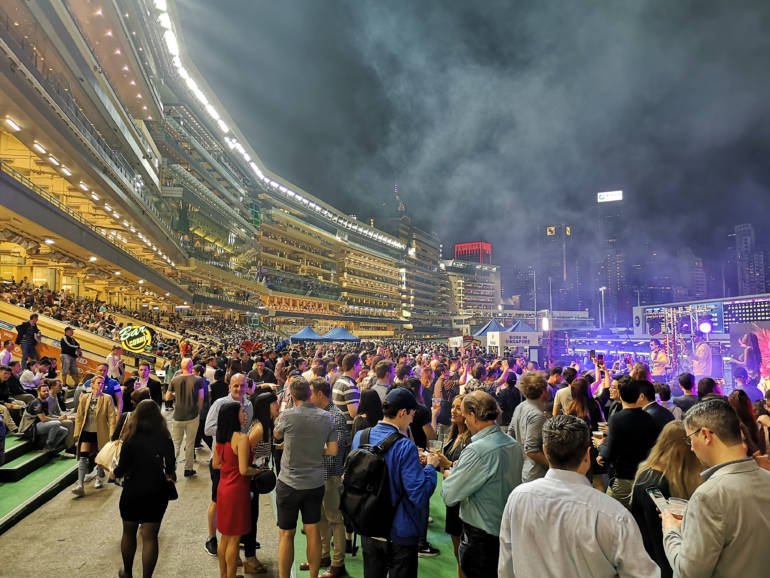
If you are planning an ingestion job, a content calendar or a model that refits weekly, the Hong Kong racing season is the first thing to pin down. It is more regular than almost any other in the sport, which is useful, and it has an awkward gap in the middle of summer, which is less so.
The figures below come from our results for the nine seasons from 2017-18 to 2025-26.
When the season starts and ends
The season opens on a Sunday in early September and finishes in mid-July. The last nine openings fall between 1 and 11 September, and the closes between 14 and 16 July.
| Season | First race day | Last race day | Race days | Races |
|---|---|---|---|---|
| 2017-18 | 3 Sep 2017 | 15 Jul 2018 | 88 | 807 |
| 2018-19 | 2 Sep 2018 | 14 Jul 2019 | 88 | 812 |
| 2019-20 | 1 Sep 2019 | 15 Jul 2020 | 86 | 818 |
| 2020-21 | 6 Sep 2020 | 14 Jul 2021 | 87 | 825 |
| 2021-22 | 5 Sep 2021 | 16 Jul 2022 | 88 | 836 |
| 2022-23 | 11 Sep 2022 | 16 Jul 2023 | 88 | 836 |
| 2023-24 | 10 Sep 2023 | 14 Jul 2024 | 89 | 841 |
| 2024-25 | 8 Sep 2024 | 16 Jul 2025 | 88 | 850 |
| 2025-26 | 7 Sep 2025 | 15 Jul 2026 | 88 | 862 |
Add the nine rows up and you get 790 race days and 7,487 races. The number of race days has barely moved, between 86 and 89 every season, but the number of races has crept up from 807 to 862, because each meeting now carries a few more of them.
The summer gap
Between the last race day in mid-July and the first in early September there is nothing. In the eight calendar years from 2018 to 2025 not a single race was run in August. July is thin, with 41 race days in total over those eight years, an average of five a year. The busiest months are January (73 days over the eight years), May (72) and October (72).
For a pipeline, that means a month and a half in which no new results will appear and nothing is broken. Do not page anyone. It is a good window for schema changes, backfills and model refits.
Which days, and where
Hong Kong never races at both courses on the same day. Over the eight years from 2018 to 2025, not one date has a meeting at Sha Tin and another at Happy Valley.
The weekday pattern is just as tidy. Happy Valley is a midweek venue: of the 302 days it raced in those years, 282 were Wednesdays. Sha Tin is a weekend venue: 265 of its 398 race days were Sundays and another 72 were Saturdays. The rest are scattered across the week, usually public holidays or rescheduled fixtures.
A typical meeting has 9 to 10 races, which also explains why the season totals above grow without any change in the number of days: one extra race on most meetings adds about 80 a year. Across the same years the average was 9.5, and no meeting had fewer than 8 or more than 11.
What this means for data work
Expect roughly 850 races a year, so about 16 a week on average, but arriving in bursts of 8 to 11 on a single day. Polling every hour is wasted effort. One that runs after each race day does everything you need, which is how our own updates work.
Remember that race times are Hong Kong local time, eight hours ahead of UTC. A Wednesday evening meeting at Happy Valley lands in the middle of the UK day, so convert before you line the two markets up on one timeline.
Be careful with annual statistics. A Hong Kong “season” crosses two calendar years, so a count by calendar year will split a single season in two. If you want comparable seasons, group from 1 September to 31 August, which is how the table above is built.
Put the summer gap in your calendar and the rest of the season runs itself. The Hong Kong racing guide covers the data behind each race day, the Hong Kong datasets start in 1979, and the API serves each day’s racecards and results after racing.
Comments are closed