


A horse race lasts between about a minute and nine minutes. Here are the distances and the winning times that go with them, measured on UK and Hong Kong results.

The Hong Kong racing season starts in early September, ends in mid-July, and has about 88 race days. Here is the pattern, measured from nine seasons of results.

A frank description of the UK and Irish racing archive: how many races, which types, what is recorded for each runner and where coverage thins out.
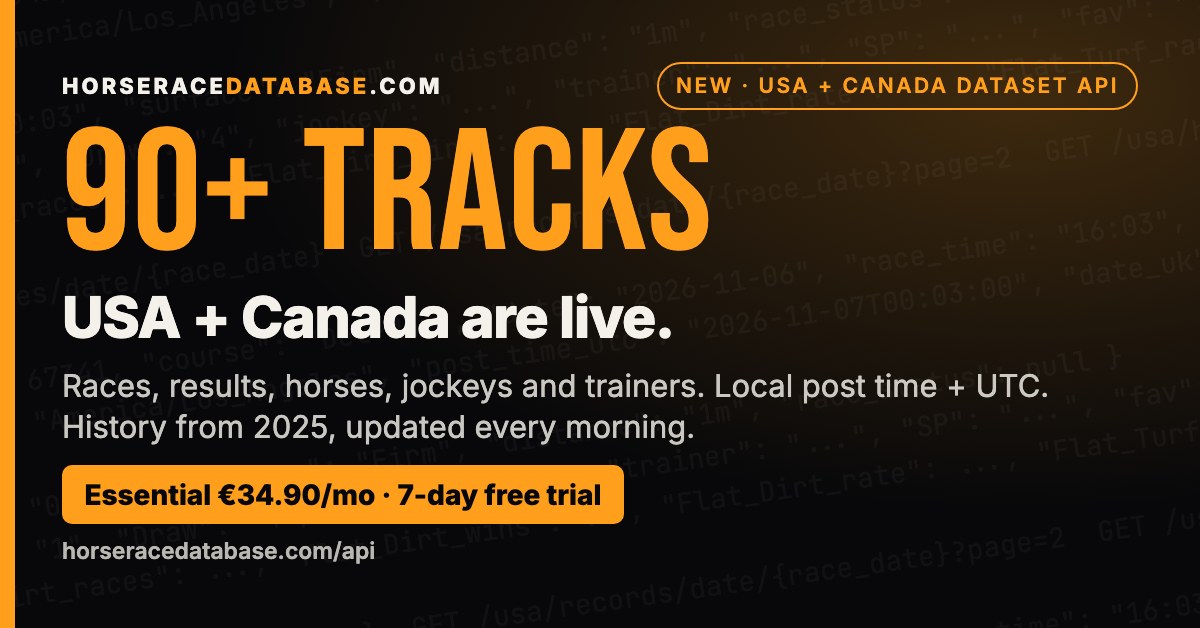
North American racing is on HorseRaceDatabase: 90+ tracks, results from 2025, racecards for today and tomorrow, and every race on its own local date.

Sectional times data for Hong Kong from 2008 and the UK from 2017. See how it joins stable IDs and integrity gates, and how to use it in your own models.

Horse racing data API or CSV, SQL and JSON dataset? Compare how each fits your volume, refresh needs and team, then choose a plan with confidence.
Horse racing data coverage explained: 2.2M results, 226K races and 173K horses across the UK, Ireland and Hong Kong, and how far back each goes.

Same name horses can merge two careers into one in racing data. See how joins break, what to test in your pipeline, and why stable IDs matter.

What TT, B, H, XB and the other gear codes on a Hong Kong racecard mean, how the suffixes work, and how to store them in a database.

Ten questions to put to any horse racing data provider, with a test for each one you can run on a sample file in an afternoon.
A set of plain statistics measured on our own UK, Irish and Hong Kong results: how big the fields are, how often horses fall, and how short most careers are.

Five checks to run on any horse racing dataset before you train on it, with a short pandas audit and the traps we have seen in real racing data.
UK race distances are text, there are about 1,900 of them, and the surface column is not what its name suggests. A practical guide with the real counts.
Recent Comments